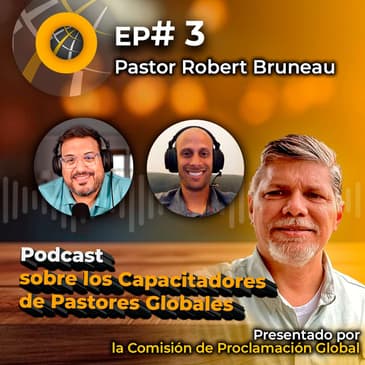
En este episodio, los anfitriones Germán Ricca y Robby Richard están acompañados por el pastor Robert Bruneau, un experimentado misionero y capacitador de pastores de Mesa Global. El pastor Robert comparte su trayectoria desde director de campamentos a mentor de pastores, y nos acerca su visión sobre el equilibrio entre el carácter y las capacidades en el ministerio. Subraya la importancia de dedicar tiempo al descanso y la reflexión para mantener la salud espiritual. Este episodio nos trae mucho ánimo y consejos prácticos tanto para los nuevos pastores como para los líderes experimentados.
Visit us in www.gprocommission.org for more information
[00:00:00] Welcome to the Podcast about Global Pastor Trainers.
[00:00:04] You are now on the way to the Global Proclamation Committee,
[00:00:08] where we have the vision to see all the Pastoral Trainers,
[00:00:11] and each Pastor is a Pastor. Let's begin.
[00:00:16] Welcome to this third episode of our Podcast.
[00:00:20] My name is German Rika,
[00:00:21] and we are very happy to be together.
[00:00:24] Once again, in the third episode, we are happy to see
[00:00:27] how the audience is growing in this Podcast.
[00:00:31] Together with Robbie Richard,
[00:00:33] we are both making this space easier with a lot of expectations.
[00:00:36] In this third episode, we have a special guest.
[00:00:40] So I want to pass the microphone to Robbie
[00:00:42] so he can introduce us to the guest.
[00:00:45] Thank you, German.
[00:00:47] Yes, it's a pleasure for all of us to be back with you.
[00:00:51] Today we have the privilege and honor
[00:00:55] to hear from Pastor Robert Bruneau.
[00:01:01] He is a short biography,
[00:01:04] and we will hear more about his part.
[00:01:07] He grew up in a ministerial family,
[00:01:10] a dedicated family,
[00:01:12] but he is a licensed person in physical education
[00:01:15] and recreation at the University of Panama,
[00:01:17] a career that I used to serve him as director
[00:01:21] of several different camps in Panama and Costa Rica.
[00:01:26] And also as executive director
[00:01:28] of the International Association of Christian Camps
[00:01:31] in Latin America.
[00:01:35] Besides that,
[00:01:36] for the last 24 years,
[00:01:39] he has been a missionary with Mesa Global,
[00:01:40] and currently serves as regional leader
[00:01:43] for South America
[00:01:45] and the energy coordinator
[00:01:47] for Latin American capacity in Mesa Global.
[00:01:51] So let's hear from him
[00:01:53] how he moved from the camps
[00:01:55] to become a pastor.
[00:01:58] He has also been married to Nina Perez
[00:02:00] for 28 years,
[00:02:02] she has two daughters, Nicole,
[00:02:04] for 23 years and Joan of 18,
[00:02:07] and currently lives in Medellin,
[00:02:10] for 8 years.
[00:02:11] And he says here that he loves life
[00:02:14] free of charge,
[00:02:16] I enjoy teaching the Bible,
[00:02:18] I identify with you with that, Robert.
[00:02:21] And he is really understanding
[00:02:22] to accompany pastors and leaders
[00:02:24] in his walk with the Lord
[00:02:26] and in his integration of Iliasco.
[00:02:28] So Robert, it's a pleasure
[00:02:31] to have you here with us today.
[00:02:35] It's a privilege for me to be with you
[00:02:38] in this third podcast.
[00:02:40] It's an honor to be able to share,
[00:02:42] listen to the previous ones
[00:02:44] and know that God is using this
[00:02:47] tool to support us,
[00:02:49] to accompany us and give us tools
[00:02:52] and ideas for our pastoral work
[00:02:54] also. Thank you for your invitation.
[00:02:57] Oh, great, great.
[00:02:58] Well, I think the first question
[00:03:00] we have for you, Robert,
[00:03:02] if you can explain a little
[00:03:04] about your life growing up
[00:03:06] and what led you
[00:03:08] to this project.
[00:03:09] First of all, I would like to
[00:03:09] thank you for your time,
[00:03:10] and then, to the ministry,
[00:03:12] but we would also like to hear
[00:03:13] about that path of
[00:03:14] head of pastors.
[00:03:20] Of course, thank you very much,
[00:03:22] Germán and Robbie.
[00:03:24] Well, I think my story
[00:03:25] can be very typical
[00:03:28] in the Christian Church,
[00:03:31] the Evangelical Church
[00:03:31] of a pastor's son.
[00:03:34] What I want to say is typical
[00:03:35] is that, thanks to God,
[00:03:38] we were born in a place
[00:03:39] where the Gospel is presented
[00:03:41] from the birth.
[00:03:44] And that is a privilege,
[00:03:46] I think it's something God
[00:03:48] decides.
[00:03:49] That is his will.
[00:03:51] And I grew up like this.
[00:03:51] I grew up in a Christian home,
[00:03:54] in a pastoral family.
[00:03:56] From the beginning it was
[00:03:58] an church that had
[00:04:00] the pastor's house next to it.
[00:04:03] So, the house and church
[00:04:05] were like a single place for me.
[00:04:08] I grew up having
[00:04:09] a room that was a room during
[00:04:11] the week and a saloon
[00:04:13] of the Dominican School on the weekend
[00:04:14] or Sunday.
[00:04:16] So, it was an integration of the life
[00:04:19] of faith and church
[00:04:21] with the house
[00:04:22] and the life of the church
[00:04:25] inside the house.
[00:04:26] However, at the age of nine
[00:04:28] or 10, I felt
[00:04:30] that
[00:04:31] it was a personal decision.
[00:04:33] The Gospel reaches my heart,
[00:04:36] not only my mind.
[00:04:38] It begins to
[00:04:39] affect the message of the Gospel
[00:04:41] and I understood it was a sin
[00:04:43] without having
[00:04:45] felt a lot of sin
[00:04:47] or a lot
[00:04:50] of pain
[00:04:51] due to sin in terms of
[00:04:54] radical consequences
[00:04:55] of drugs and abuse
[00:04:57] and other testimonies
[00:04:59] that are also there, but there was
[00:05:00] a strong conviction
[00:05:03] that it was a sin
[00:05:04] and that helped me understand
[00:05:06] that I needed something
[00:05:07] and someone to save me.
[00:05:10] So, it was a response
[00:05:12] of God to listen to the Gospel
[00:05:13] and to pass my mind
[00:05:16] through my heart.
[00:05:17] Obviously, my parents were
[00:05:20] influenced
[00:05:21] by the transition
[00:05:23] and also
[00:05:24] the Dominican School, the camps
[00:05:26] at that time
[00:05:28] the school of holiday holidays.
[00:05:30] All those traditional experiences
[00:05:32] of the church
[00:05:33] were giving their contribution
[00:05:36] little by little
[00:05:37] to my conversion
[00:05:39] or to my confession of faith
[00:05:41] in Jesus Christ and since nine years
[00:05:43] it has been a walk with the Lord
[00:05:47] complete
[00:05:48] a delivery
[00:05:50] without a doubt
[00:05:51] as that song says
[00:05:53] I will not go back, I will not go back
[00:05:56] and at nine years it was that decision
[00:05:58] of faith.
[00:05:59] And the Lord was
[00:06:02] equipping me
[00:06:02] the church has always been a place
[00:06:04] of training, of growth
[00:06:08] also a place
[00:06:09] of development of leadership
[00:06:11] but I want to connect
[00:06:13] my experience of the son of pastor
[00:06:15] that I think is also very common
[00:06:19] in many
[00:06:20] who listen
[00:06:21] I understand the pastoral life
[00:06:25] since childhood
[00:06:26] I mean, I'm not
[00:06:29] involved in the formation
[00:06:31] of pastors because I made a transition
[00:06:34] but because I understand
[00:06:36] the reality of the pastoral families
[00:06:38] and the needs
[00:06:40] that the children of the pastors live
[00:06:42] and the family
[00:06:43] of the pastors and obviously the pastor
[00:06:46] and his wife
[00:06:47] that has always
[00:06:49] given meaning to what I do
[00:06:52] I think
[00:06:53] it is something that the Lord uses
[00:06:55] to start
[00:06:57] creating a need
[00:06:59] of ministry to the future
[00:07:01] at least to me, he did it like that
[00:07:03] gave me a great experience
[00:07:05] of pastoral family
[00:07:07] and now I understand what I'm doing
[00:07:11] Wow
[00:07:12] Wow, that's great
[00:07:13] and Robert
[00:07:14] I imagine that many people who are listening
[00:07:17] right now will feel identified with your
[00:07:19] history, to have been born in a Christian
[00:07:21] home and have transitioned
[00:07:23] and walk in the Lord
[00:07:24] how did you get to that
[00:07:27] space of embracing
[00:07:29] what you are doing today with Mesa Global
[00:07:31] how was that journey
[00:07:33] and if you can tell a little
[00:07:34] in detail what you are doing with Mesa Global
[00:07:37] of course
[00:07:39] I think it is important
[00:07:40] to understand that God uses all the
[00:07:43] ministries and spaces for training
[00:07:45] He does not
[00:07:47] leave out
[00:07:50] the opportunities
[00:07:52] to train you
[00:07:53] some in a very prolonged desert
[00:07:55] of difficulties
[00:07:56] of weaknesses
[00:07:58] of confusion
[00:08:00] and others put us
[00:08:02] in services, of collaboration
[00:08:05] of learning from others
[00:08:07] I, the Lord, thank God
[00:08:09] I had the blessing
[00:08:10] of being accompanied by
[00:08:14] mentors
[00:08:15] and Christian leaders
[00:08:17] older than me
[00:08:19] they are all part of the
[00:08:21] contribution God made in my training
[00:08:24] many of them
[00:08:25] or most of them pastors
[00:08:27] including my father
[00:08:31] put a discipline
[00:08:33] of study of the Bible
[00:08:34] of spaces of reflection
[00:08:37] in writing
[00:08:38] theological knowledge
[00:08:40] that process, although it is a little long
[00:08:43] 12 years I knew that the Lord
[00:08:45] was calling me to the ministry
[00:08:48] at 16 or 17
[00:08:50] I was
[00:08:51] accompanying my father
[00:08:52] in some tasks of preaching
[00:08:54] of teaching, of collaboration
[00:08:58] and what I want to say with this
[00:09:00] of the services
[00:09:02] and the spaces that God
[00:09:04] does not lose opportunities in those spaces
[00:09:06] is that the camps
[00:09:08] despite being seen as
[00:09:10] a very place to play
[00:09:12] and children
[00:09:14] really the camps
[00:09:16] were a space
[00:09:18] of leadership training
[00:09:21] when you talk about leadership
[00:09:22] you think about the leader
[00:09:25] who directs, who commands
[00:09:26] who controls
[00:09:27] who has the power
[00:09:29] to manage people
[00:09:32] however
[00:09:33] the beginning of the biblical leadership
[00:09:35] is a leadership of service
[00:09:37] that is to say, learn to serve
[00:09:38] and the camps really offer
[00:09:41] that first opportunity to serve in the kitchen
[00:09:43] to serve in the pool
[00:09:45] if you have a pilot or a pool
[00:09:47] to take the children
[00:09:50] to a meeting in a tree
[00:09:51] and share the Gospel
[00:09:53] the word in the natural environment
[00:09:55] the camps are like a level
[00:09:58] to me helped me
[00:10:00] a level of training
[00:10:01] in that experience of leadership
[00:10:03] and that made me
[00:10:05] see myself as a camp director
[00:10:07] to meet many pastors
[00:10:09] because as I was the director
[00:10:11] I received many churches
[00:10:13] and shared with many pastors
[00:10:15] in my office I had very important conversations
[00:10:19] to my 25, 30, 35 years
[00:10:23] and the pastor approached me
[00:10:27] telling me his story
[00:10:29] today
[00:10:30] all those stories
[00:10:31] have an accumulation
[00:10:33] of experiences
[00:10:34] to be able to accompany
[00:10:36] and the transition was not more
[00:10:38] than the Lord gave me the opportunity
[00:10:40] to enter the global table
[00:10:42] 24 years ago
[00:10:44] as a missionary
[00:10:46] and despite
[00:10:47] that cultures seem to be much
[00:10:51] in Latin America if I had a trans
[00:10:53] cultural experience
[00:10:54] travel throughout Latin America
[00:10:56] meet many pastors
[00:10:59] develop working teams
[00:11:01] in some countries
[00:11:02] now we have 10 countries
[00:11:05] through the alliance of CCI
[00:11:07] Christian camps
[00:11:08] and then global table
[00:11:10] I need you to join us
[00:11:13] in an initiative to accompany pastors
[00:11:15] and leaders in the region of South America
[00:11:18] that's what I'm doing right now
[00:11:19] and we have a network of pastors
[00:11:22] and leaders
[00:11:24] in South America
[00:11:25] missionaries
[00:11:26] that are attending congregations
[00:11:29] others are attending foundations
[00:11:31] with children
[00:11:32] in vulnerability
[00:11:34] and my job now is
[00:11:37] more or less to pastor
[00:11:38] a team of almost 35
[00:11:41] pastors and leaders
[00:11:43] and missionaries who are in the area
[00:11:44] of South America including Cuba
[00:11:47] Panama
[00:11:48] and that's a bit
[00:11:50] what pastor is a call
[00:11:53] but it's also a great responsibility
[00:11:56] and
[00:11:57] that transition
[00:11:59] has not been so fast
[00:12:01] has taken its time
[00:12:03] to be able to do
[00:12:04] with quality and enthusiasm
[00:12:07] the task of
[00:12:08] to sit down and accompany pastors
[00:12:13] that's good
[00:12:15] I'm listening to the story
[00:12:16] and then there's a
[00:12:18] formation line
[00:12:18] starting with your father
[00:12:21] and now
[00:12:22] from you to others
[00:12:25] in fact, many questions come to me
[00:12:27] first
[00:12:29] or comments
[00:12:30] first it's impressive
[00:12:32] to see your parents
[00:12:34] include you in the ministry
[00:12:37] and I think that we can often fail
[00:12:39] to see our family
[00:12:41] as an ally
[00:12:44] an ally
[00:12:45] to what we are doing in the ministry
[00:12:47] sometimes we tend to see them as a
[00:12:49] a pastor or something like that
[00:12:50] and we see the effects of that
[00:12:52] in many children
[00:12:54] and resentment
[00:12:55] and everything that many of us have seen
[00:12:59] but also
[00:13:00] that multiplication
[00:13:02] or that discipline
[00:13:03] that training, that training
[00:13:05] whatever we want to call it
[00:13:07] how do you see
[00:13:09] now you mentioned
[00:13:11] that you have more than 30
[00:13:13] different leaders, pastors
[00:13:15] that you are
[00:13:17] on them, you are in charge
[00:13:19] of taking care of them
[00:13:21] what are some
[00:13:23] maybe
[00:13:25] innovations or challenges
[00:13:27] that you have had to face
[00:13:28] and overcome those challenges
[00:13:30] or whatever
[00:13:31] you as a global month
[00:13:34] or you as a part of the global month
[00:13:36] if there is a
[00:13:38] strategy, something that
[00:13:39] you are working on, what do you do?
[00:13:44] Yes, well
[00:13:44] the first thing is
[00:13:47] it's not so innovative
[00:13:48] but I think it's important
[00:13:50] to visit, to be with people
[00:13:55] obviously South America is a region
[00:13:57] quite extensive in geography
[00:13:59] so it requires
[00:14:01] a visit
[00:14:03] a personal visit
[00:14:06] not
[00:14:07] not only
[00:14:10] pauline letters
[00:14:11] what gives encouragement
[00:14:12] that's important
[00:14:13] to write, to send messages
[00:14:16] that's what we do
[00:14:17] it's not so innovative but now everyone is writing
[00:14:20] on the networks and sending messages
[00:14:22] by letter
[00:14:23] but I think something that we have lost
[00:14:26] is to stay in the houses
[00:14:28] of some pastors
[00:14:31] and
[00:14:31] and that seems like
[00:14:33] I invite myself
[00:14:35] but the reality
[00:14:38] is that we are already so familiar
[00:14:40] and we have reached
[00:14:42] a relationship so deep
[00:14:43] that living together
[00:14:45] being with them
[00:14:47] some are missionaries
[00:14:49] of many experiences
[00:14:51] and being with them
[00:14:53] and eating, enjoying
[00:14:55] walking out, listening to their stories
[00:14:58] many of them say
[00:15:00] I don't have those spaces
[00:15:02] very regularly with another leader
[00:15:05] and they really appreciate
[00:15:06] when one takes two or three days
[00:15:08] to stay with them
[00:15:09] play with the children
[00:15:11] I think it's a leadership model
[00:15:14] to be present
[00:15:16] and not only
[00:15:17] to be giving content
[00:15:20] for me the presence
[00:15:22] of a leader
[00:15:24] is very Christo centric
[00:15:26] it's very embodying
[00:15:28] the model of Jesus
[00:15:29] to be a fried fish
[00:15:31] at the edge of a river
[00:15:34] and at the edge of a river
[00:15:36] well
[00:15:38] until you feel the smell
[00:15:40] of the conversation
[00:15:42] let's say, it becomes more
[00:15:44] more deep, more
[00:15:46] closer
[00:15:46] and I think that's something we
[00:15:50] are trying to do
[00:15:51] as a routine
[00:15:53] I think there is another
[00:15:55] challenge for us
[00:15:57] especially for me
[00:15:58] and it's the balance
[00:16:00] in how we manage time
[00:16:03] now, this has to do with
[00:16:05] any shepherd in any area
[00:16:07] and in any culture
[00:16:09] we don't know
[00:16:11] how to stop
[00:16:13] and a challenge
[00:16:14] is to find those spaces to stop
[00:16:16] and go visit the other one that is also occupied
[00:16:20] for me
[00:16:22] is to create a rhythm
[00:16:23] and I think that's something
[00:16:25] that both in training
[00:16:27] and in the shepherd training
[00:16:29] I teach a lot
[00:16:31] and try to encourage it
[00:16:33] in the shepherd
[00:16:34] and it's before entering a year
[00:16:36] plan to stop
[00:16:38] don't wait until you are
[00:16:41] tired to say
[00:16:42] look, I need to stop
[00:16:45] because when you
[00:16:46] are in the field
[00:16:47] now we are very famous
[00:16:48] the burnout
[00:16:49] it's very common
[00:16:50] and emotional charges
[00:16:53] look, the first thing
[00:16:54] that they ask you when you are in
[00:16:55] burnout is to get
[00:16:56] a space of rest
[00:17:00] another recommendation
[00:17:01] is to look for an office
[00:17:02] a hobby
[00:17:03] something that can serve you
[00:17:05] to distract your mind
[00:17:06] I start to think
[00:17:08] why don't I do that
[00:17:09] as a cycle of my life
[00:17:11] to get the space to stop
[00:17:14] and look for a hobby
[00:17:15] something recreational that can help me
[00:17:17] to make a cycle
[00:17:18] and that helps me to have
[00:17:21] a healthy time
[00:17:23] today, the pastors and leaders
[00:17:25] we don't know how to stop
[00:17:27] and the truth is
[00:17:28] Germany, Robby
[00:17:30] worries me a lot
[00:17:31] that feeling of
[00:17:33] I feel very proud when I say
[00:17:35] I don't have time
[00:17:37] this is our practice
[00:17:39] a personal practice
[00:17:41] is to intentionally
[00:17:43] get some pastors
[00:17:45] pastors from the city
[00:17:47] and go to a hotel
[00:17:50] to rest, talk
[00:17:53] there's not much biblical content
[00:17:55] we even ask the pastors
[00:17:58] that next Sunday
[00:17:59] don't be what they preach
[00:18:01] so that they can be
[00:18:02] in the real rest
[00:18:04] of stopping
[00:18:05] it's not just stopping
[00:18:07] it's not going down the speed
[00:18:09] it's not taking a break
[00:18:11] it's really stopping
[00:18:13] and that's very difficult
[00:18:16] and it's a practice
[00:18:17] we're trying to do with our pastors
[00:18:20] and those of us who are training
[00:18:22] even those church leaders
[00:18:24] who are starting a life rhythm
[00:18:26] it's so good to hear that
[00:18:29] I think
[00:18:30] the other part
[00:18:32] of that, we don't know
[00:18:34] how to stop
[00:18:36] but also the expectations
[00:18:38] of others that we don't stop
[00:18:40] as pastors
[00:18:41] I just heard a story
[00:18:43] actually in Medellin
[00:18:44] a pastor was saying
[00:18:47] once a pastor was
[00:18:50] resting
[00:18:50] he was outside the house
[00:18:52] in a hammock
[00:18:52] and one of the church leaders
[00:18:55] said to him, pastor
[00:18:56] what are you doing?
[00:18:59] and he was resting
[00:19:01] and he said, but the devil never rests
[00:19:04] and he said
[00:19:06] well, that's why I don't want to be like the devil
[00:19:11] that pressure
[00:19:12] of the people who say the pastor should be doing
[00:19:15] everything
[00:19:16] but when we talk about the health
[00:19:20] of the pastor
[00:19:21] then if the pastor is not healthy
[00:19:23] they won't be healthy either
[00:19:26] you know what even Robbie
[00:19:27] I've been listening recently
[00:19:29] that there's another topic
[00:19:31] to add to the complexity
[00:19:33] we don't know how to rest
[00:19:36] we're so used
[00:19:37] by the external pressure
[00:19:39] of having to do
[00:19:40] and we feel like, as Robert said
[00:19:42] super good to say
[00:19:45] I have my full agenda
[00:19:46] I don't have a break
[00:19:47] that when we rest
[00:19:48] we're close to a burnout
[00:19:51] or someone came to the German
[00:19:54] and said
[00:19:54] we don't know how to do it
[00:19:57] and we think we can't do anything
[00:19:58] to stay in that pause
[00:20:00] and feel uncomfortable
[00:20:01] and we don't know how to interact
[00:20:03] so I really see Robert
[00:20:06] and I thank you for your comment
[00:20:08] is this Ministry of Presence
[00:20:11] I think that's the key
[00:20:13] I think we're hitting the nail
[00:20:15] as it says
[00:20:16] we're reaching something that's real
[00:20:18] and a few days ago
[00:20:20] we finished a meeting
[00:20:21] every first Monday of the month
[00:20:24] we gathered for Zoom
[00:20:25] a group of 140 people
[00:20:27] and one of the topics that came up
[00:20:28] in this
[00:20:29] how to raise new pastors
[00:20:32] we need time
[00:20:35] but not time as you said
[00:20:38] it's time to make
[00:20:40] the decision to spend
[00:20:42] a season
[00:20:43] a few days with the person
[00:20:44] and from that space
[00:20:47] to help him to move forward
[00:20:49] in what God has for that person
[00:20:51] so really Robert
[00:20:53] I celebrate these two points
[00:20:54] although as I said
[00:20:55] maybe it's not innovative
[00:20:56] but to return to the root
[00:20:58] of how the Lord did things
[00:21:02] today it still sounds innovative
[00:21:04] I think practically
[00:21:06] practically
[00:21:09] it's something
[00:21:10] that nobody does
[00:21:12] we had
[00:21:13] a retreat
[00:21:16] when I say retreat
[00:21:17] we need to take care of it
[00:21:18] we actually retreated
[00:21:22] from the city
[00:21:23] almost 25 pastors
[00:21:24] and
[00:21:27] one of the things that we mentioned
[00:21:30] in the conversation
[00:21:31] because it was conversations
[00:21:33] in the morning
[00:21:34] was
[00:21:35] that God
[00:21:38] created man for a rhythm
[00:21:40] his first day
[00:21:42] which was the first day of Adam
[00:21:44] it was
[00:21:46] the day of rest
[00:21:48] really, of course
[00:21:49] so we have
[00:21:52] a cycle
[00:21:54] of life, of work and of rest
[00:21:56] Jesus lived it
[00:21:58] worked to a ministry
[00:21:59] but he took out his disciples
[00:22:01] there was a constant practice
[00:22:02] of retreating out of the city
[00:22:05] and the devil
[00:22:07] knows that there is
[00:22:09] blessing
[00:22:09] there is a blessing in stopping
[00:22:13] because when you stop
[00:22:15] you have an opportunity to reflect
[00:22:18] look back
[00:22:19] and really look back
[00:22:21] and say wow
[00:22:23] how many things the Lord has done
[00:22:25] look at the present
[00:22:26] and say wow
[00:22:27] look what the Lord has given me
[00:22:30] but you have the opportunity to look at the future
[00:22:32] and say I have hope
[00:22:34] but that cannot be done
[00:22:36] when you are running
[00:22:39] and running
[00:22:40] makes you lose the signals
[00:22:42] when you are on a big highway
[00:22:44] and you drive very fast
[00:22:46] and excess speed
[00:22:47] makes you lose signals
[00:22:49] and sometimes we just want to
[00:22:52] lower the speed
[00:22:53] there are moments with the pastors
[00:22:55] like the devil knows
[00:22:57] that there is a great blessing
[00:22:59] in stopping
[00:23:00] and focusing again on Jesus
[00:23:02] in a regular and constant
[00:23:06] cycle
[00:23:06] the first temptation
[00:23:08] is to keep ourselves busy
[00:23:11] and give us more tasks
[00:23:12] and blame us
[00:23:14] because we are resting
[00:23:15] because he knows that there is a great blessing
[00:23:18] because it is a command
[00:23:20] it is not a suggestion
[00:23:22] it is within the list of the commandments
[00:23:24] it is not
[00:23:26] and I think that many of us
[00:23:27] are not at least
[00:23:29] with the stop regularly
[00:23:31] with that command
[00:23:32] and what a pity that we
[00:23:36] let's say we have not had to
[00:23:38] develop a theology
[00:23:39] of
[00:23:42] let's say of the adult
[00:23:44] we do not have to
[00:23:46] develop a theory
[00:23:48] of idolatry
[00:23:49] or a philosophy
[00:23:50] but we have had to write
[00:23:52] and we have a book about the theology
[00:23:55] of recreation and rest
[00:23:56] like you have to look for that
[00:23:59] exam of why we have to rest
[00:24:01] and you have to explain to the pastors
[00:24:03] with a lot of biblical conscience
[00:24:05] why to stop
[00:24:07] when it is a command
[00:24:08] it is simply an order of God
[00:24:11] to stop
[00:24:12] and it is written
[00:24:13] and it has been remembered
[00:24:15] throughout the biblical history
[00:24:18] so I think
[00:24:19] it is a conscience
[00:24:21] of the leader
[00:24:23] and here I want to only
[00:24:24] to admit that it is not only for the pastors
[00:24:28] I think
[00:24:29] in the discipline
[00:24:30] that is why the demands
[00:24:32] of the congregation
[00:24:33] like the sister who told the pastor
[00:24:36] that the devil does not rest
[00:24:37] is because we are not
[00:24:39] we are not teaching
[00:24:41] the process of rest
[00:24:42] to our church
[00:24:44] and we use
[00:24:47] any pretext
[00:24:48] and it is also culture
[00:24:50] there is an ethics of work
[00:24:52] there is a whole history
[00:24:53] there is a literature
[00:24:56] about the subject of work
[00:24:59] and rest
[00:25:00] that sometimes also confuses
[00:25:02] and makes us think
[00:25:04] that the hatred
[00:25:07] is the mother of all the vices
[00:25:10] and
[00:25:10] and that's why I think
[00:25:12] there is an important reflection
[00:25:12] so that the pastor can also go teaching
[00:25:16] and maybe
[00:25:17] do things with the congregation
[00:25:19] in a day of rest
[00:25:22] it is like a new owner
[00:25:24] part of that
[00:25:25] is our own
[00:25:28] independence
[00:25:30] and autonomy
[00:25:32] that we
[00:25:34] can
[00:25:34] or we
[00:25:35] will go ahead
[00:25:38] and be the savior of our congregation
[00:25:41] or whatever
[00:25:42] so in reality it is still
[00:25:44] still in our identity
[00:25:46] and that's why when I see pastors
[00:25:48] that are no longer pastors
[00:25:49] they don't know how to do
[00:25:52] they don't know how to live
[00:25:53] because they have already taken away
[00:25:55] that identity of the pastor
[00:25:56] to respond to all the needs
[00:25:58] of the people
[00:25:59] that is good but they have found
[00:26:00] their whole being in that
[00:26:03] and they have pushed them
[00:26:05] and we justify it because we are in ministry
[00:26:08] so if we go to another thing
[00:26:10] then people realize that it's not good
[00:26:12] but being in ministry
[00:26:14] we don't justify it
[00:26:16] us
[00:26:17] so thanks for that
[00:26:19] and I was very applicable to those who are listening
[00:26:22] to finish
[00:26:24] Robert we didn't want to take a long time
[00:26:26] but maybe based on that
[00:26:28] it could be something else
[00:26:29] but what would be your
[00:26:30] or suggestion
[00:26:34] or some words
[00:26:35] that you would say
[00:26:36] to new pastors
[00:26:39] and pastors
[00:26:40] who are starting on that
[00:26:43] how would you
[00:26:47] encourage them
[00:26:47] to start
[00:26:49] and what they are doing
[00:26:52] I think
[00:26:54] that the
[00:26:54] I am very encouraged
[00:26:56] the Salmo 78-72
[00:26:59] is a
[00:27:00] passage
[00:27:01] that gives me a balanced life
[00:27:05] of David
[00:27:07] we generally when we talk about
[00:27:09] pastor
[00:27:10] accompanying pastors
[00:27:12] or pastorizing pastors
[00:27:15] we go a lot for the
[00:27:17] stress
[00:27:18] for the doing of the pastor
[00:27:21] for
[00:27:23] giving him more tools
[00:27:25] and ideas
[00:27:25] and the evangelism and the discipline
[00:27:27] and how he goes with the church
[00:27:29] however this text
[00:27:31] tells me
[00:27:33] that he was a pastor
[00:27:35] who was in accordance with
[00:27:37] the integrity of his heart
[00:27:39] and that has to do with the character
[00:27:43] and the character
[00:27:45] develops
[00:27:47] when you have a rhythm
[00:27:49] a balance
[00:27:51] when
[00:27:53] you take time to develop that character
[00:27:56] when you observe
[00:27:58] the present and the future in a time of
[00:28:01] rest, of stop
[00:28:03] is where you can examine
[00:28:04] how you are growing
[00:28:05] and when you are a pastor
[00:28:09] of pastors you must
[00:28:10] give a first
[00:28:12] a first step
[00:28:13] of learning to stop
[00:28:17] that is how to treat the content
[00:28:19] but the character
[00:28:20] is very important
[00:28:21] the being of the person
[00:28:22] that's why the presence is very important
[00:28:24] because you are
[00:28:26] and you can't hide
[00:28:28] who you are in the house of another
[00:28:30] you are
[00:28:31] and for me that character
[00:28:34] is modellable
[00:28:38] modellable
[00:28:39] that is to say we give it to model in your life
[00:28:42] the other part of the Psalm
[00:28:44] and it says
[00:28:44] and pastor you with the
[00:28:47] pericia of your hand
[00:28:48] there were de-stress, qualities
[00:28:51] certain tools that you could
[00:28:53] use to pastor
[00:28:55] I think the balance between
[00:28:58] character
[00:29:00] which is the being
[00:29:01] but also learning to do it
[00:29:04] is to develop
[00:29:06] abilities
[00:29:07] but also develop
[00:29:09] the character and the being of the person
[00:29:11] so there are some pastors
[00:29:14] that have a lot of de-stress
[00:29:16] to be able to preach
[00:29:17] and teach the Bible well
[00:29:18] but in their character
[00:29:21] they are still iraqs
[00:29:22] we still have
[00:29:23] some things to correct
[00:29:26] there are others that we are very vulnerable
[00:29:29] if we have some but we don't have
[00:29:31] many abilities to direct
[00:29:32] I think a soul is to learn
[00:29:35] from that balance between character
[00:29:38] and the pericia
[00:29:40] of the hands
[00:29:41] and to be present
[00:29:42] in the life of the people
[00:29:44] take time to
[00:29:48] I think a soul
[00:29:50] and that is something that I am living
[00:29:52] is not only to think
[00:29:54] in people outside
[00:29:55] as a congregational and a rebaño
[00:29:58] but also in your first congregation
[00:30:00] which is your family
[00:30:02] I was
[00:30:04] and I will finish this very briefly
[00:30:07] one day
[00:30:08] the Lord raised me at 3 in the morning
[00:30:10] and took me to that church
[00:30:13] 34
[00:30:14] and I started reading
[00:30:15] that punishment to the pastors
[00:30:19] that
[00:30:20] that judgment
[00:30:21] that I gave you pastors
[00:30:23] and even the whole chapter designed
[00:30:27] and I will tell you the truth
[00:30:28] I did not think in my first congregation
[00:30:31] of
[00:30:32] I thought in my family
[00:30:35] in my wife
[00:30:36] and in my daughters
[00:30:38] I said wow
[00:30:39] what am I doing
[00:30:41] how long I am giving
[00:30:43] too much to be busy
[00:30:45] with people outside
[00:30:47] and probably I am taking care
[00:30:49] of my first rebaño
[00:30:51] that is very close to me
[00:30:52] my presence of taking care
[00:30:55] of my rebaño more close
[00:30:57] also caught my attention
[00:30:59] and one word of encouragement
[00:31:01] not only we dedicate a ministry
[00:31:03] I think of presence with people
[00:31:05] that we are accompanying
[00:31:07] but also take care of our
[00:31:09] main rebaño or permanent
[00:31:11] that is our family
[00:31:13] that they will accompany us
[00:31:16] the rest of our lives
[00:31:17] thank you
[00:31:18] wow thank you very much Robert
[00:31:21] I want to thank you
[00:31:23] for being in this episode
[00:31:25] but also thank you for your vulnerability
[00:31:27] and the word of advice
[00:31:29] in this balance
[00:31:31] between character and capacities
[00:31:34] and
[00:31:35] looking at our family as a first place
[00:31:37] where
[00:31:38] to practice the ministry of presence
[00:31:41] thanks to all
[00:31:43] who are also listening
[00:31:45] thanks for being present
[00:31:46] in this episode we want to listen
[00:31:48] of you know of you
[00:31:50] so we want to cheer you up
[00:31:52] so that they write us on social networks
[00:31:54] in chief pro commission
[00:31:55] so that you can write us
[00:31:57] in this comment
[00:31:58] what you think of this episode
[00:32:00] what you think of this podcast channel
[00:32:03] as we said we are growing
[00:32:04] in the audience
[00:32:05] thanks to the global gentlemen
[00:32:07] and we have the possibility of listening
[00:32:09] of men like in this day of Robert
[00:32:11] of a pastor who is capable of pastors
[00:32:14] and among all the beautiful messages
[00:32:16] that he has given us in this time
[00:32:18] is to take into account
[00:32:19] of the intentionality
[00:32:21] to work with people
[00:32:23] and have a vulnerable heart
[00:32:25] with a pure character
[00:32:27] and letting the Lord work
[00:32:28] so thanks for being
[00:32:30] Robin do you have any final words
[00:32:33] thank you very much
[00:32:34] that little exhibition
[00:32:36] of Salmos 78
[00:32:39] 72
[00:32:40] very impressive
[00:32:41] I will be thinking about that
[00:32:45] Robert if someone wanted to contact you
[00:32:47] what would be the best way
[00:32:48] to get in contact with you
[00:32:50] if the best way is
[00:32:53] to write
[00:32:54] obviously the whatsapp is a very easy
[00:32:57] to connect right now
[00:32:58] but my email is
[00:33:00] very easy is rbruno
[00:33:02] at robamesaglobal.co
[00:33:06] ok excellent
[00:33:07] thank you very much for being with us
[00:33:10] thanks to all those who are listening
[00:33:12] and until next time
[00:33:54] see you in the next episode