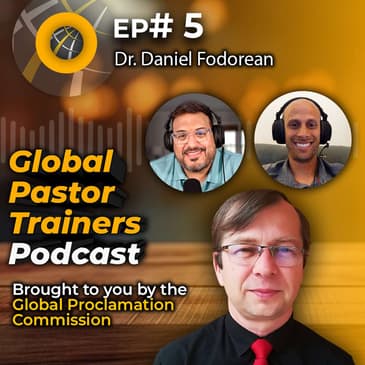
In this episode, we sit down with Dr. Daniel Fodorean, from the European Leader Formation Network, to hear the story of how the Lord called him to be a trainer of trainers of pastors, and what some of the challenges are in training pastors worldwide today.
Visit us in www.gprocommission.org for more information
[00:00:00] Welcome to the Global Pastor Trainers Podcast, brought to you by the Global Proclamation Commission, where we have the vision to see all pastoral leaders trained and every pastor a trainer. Let's get started.
[00:00:13] Welcome everyone back to the Global Pastor Trainers Podcast. My name is Robbie Richard. I'm here with Germán Rica and our guest for today, who is Dr. Daniel Fodorian.
[00:00:24] And we're so excited to get to hear from you, Dr. Fodorian, Brother Daniel, thank you for being here with us. Germán, why don't you introduce us to him and then we'll get into our conversation.
[00:00:36] Thank you, Robbie. And welcome everybody again to this new episode that we are having here. We are very excited. Today we have a special guest.
[00:00:45] Dr. Daniel Fodorian. He's the Dean of the School of Theology at the Baptist Theological Institute of Bucharest. And also he is an Associate Professor of Applied Theology.
[00:00:59] He directs the European Leader Formation Network and the Antioch Church Network. He has more than 30 years of pastoral experience.
[00:01:10] And Daniel is an expert in church transformation, leadership and church planting. He holds a PhD on theology and he's pursuing his second one in constitutional law.
[00:01:23] Wow, that sounds like a lot of work, my friend. And he also published several books and articles. He's married to Felicia and they both had a son called Nathaniel.
[00:01:35] So let's welcome Dr. Daniel Fodorian. Thank you very much. Thank you for inviting me.
[00:01:41] You're very welcome. Dr. Fodorian, part of our audience here, they want to hear from different trainers of pastors, their journey, how they became trainers of pastor, how they met the Lord.
[00:01:57] We understand that through our own stories, we can find very good pearl that we can kind of grab it and try to apply in our context.
[00:02:08] So would you just tell us a little bit about your journey, how you met the Lord and how you became a trainer of pastors?
[00:02:16] I will share with you about my walking with the Lord, my experience in walking with the Lord.
[00:02:24] Romania was a communist country for 40 years.
[00:02:28] I was born during the communist period and becoming an evangelical Christian then was a big challenge.
[00:02:39] Whatever, my parents were Baptists, people who affirm and practices their faith in Christ.
[00:02:50] And when I was 12 years old, God called me to follow him and was a blessing to understand better and better this calling.
[00:03:03] And I remember how I started connecting my life, not just with the Lord, but with the church.
[00:03:14] And during that time, I learned what it means really to serve the Lord, what it means to commit your life to the Lord, but also what it means to serve the Lord.
[00:03:24] Everything was a sacrifice.
[00:03:27] You need to give yourself to the Lord.
[00:03:34] He gave you his eternal life and eternal life, and he gave you his son.
[00:03:44] But in response to that, we need to give our lives to the Lord.
[00:03:48] And that was how I started my journey with the Lord.
[00:03:54] After that, God put in my heart the desire to become a missionary.
[00:04:03] And missionary in Romania at that time was a dream.
[00:04:08] It was missionary where?
[00:04:11] The border was close to go where to go.
[00:04:15] And I read a lot of stories about missionaries in Africa, in other continents.
[00:04:22] I want to be one day a missionary, but it was impossible.
[00:04:28] I live in an impossible time.
[00:04:30] And to serve the Lord was hard, but also to become a missionary was harder.
[00:04:41] To become a pastor was harder.
[00:04:43] But in my heart was I want to become a missionary.
[00:04:46] And I decided to go to seminary.
[00:04:49] In 1989, God bring a miracle for our country.
[00:04:54] The comments fall down.
[00:04:56] I was in the last year of high school.
[00:04:59] And I said, okay, now is my chance to go to the seminary.
[00:05:05] And I entered.
[00:05:06] And that was a blessing.
[00:05:08] I say, praise the Lord.
[00:05:09] I am in seminary.
[00:05:10] I will start studying the Bible.
[00:05:13] And I studied for four years here in Bucarest.
[00:05:16] And then, during this time of study in Seminary.
[00:05:22] We call Seminary, but I want you to understand.
[00:05:25] We call Seminary, but it's Bible College.
[00:05:27] Bible College here is for four years.
[00:05:31] And during this time, they sent me in Constanza, the Black Sea.
[00:05:36] I accepted to be there to start pastoring in 1994.
[00:05:41] And my first challenge was, okay, I'm a pastor, but I have, I think, six or seven churches.
[00:05:53] There was no pastors.
[00:05:54] And how you do, you go one Sunday to a church in the morning, in the evening to another church, next Sunday in a...
[00:06:03] And you rotate.
[00:06:05] It's like a rotation.
[00:06:06] And I think that was not pastoring.
[00:06:09] And I say, no, no, I think this is church visitation or church preaching, but pastoring is more than this.
[00:06:17] And I said, okay, what I will do is I will try to invite pastors and raise pastors in the area in order to cover the need for pastors in my area.
[00:06:34] And that is what I've done.
[00:06:36] I started training center in my church and was center for training and mission also.
[00:06:48] And training the pastors in the ministry field, it's good.
[00:06:56] I think it has a lot of advantage, but also combined with the theological education, I think also this intersection is very good.
[00:07:05] Formal and non-formal, informal education are important.
[00:07:12] All three of these are important.
[00:07:16] And this is how I understand the need to be involved in training others and training pastors.
[00:07:27] But also I look around me and I say, okay, we don't have too many churches.
[00:07:32] Let's start churches.
[00:07:34] And I start in about 10 years, I put together a church movement to start churches.
[00:07:44] And as a result, we planted about around 50 new churches in the area.
[00:07:53] But these new churches need pastors, you know, church need pastors.
[00:07:59] Pastors need churches.
[00:08:02] This relation, it's very close and we cannot cut this relation between pastor and church.
[00:08:12] And this is how I started to be involved in training pastors in the local church, in the area.
[00:08:24] And something happened during that time.
[00:08:33] My idea for having more pastors was more related with quantity.
[00:08:39] We need more pastors.
[00:08:42] After a while, I said, okay, I have more pastors, but still we have problems and issues in the churches.
[00:08:51] Why?
[00:08:52] Because it's not enough just to have pastors, but we need to have not just more pastors, but you need to have a godly pastors.
[00:09:03] And I realize it's not just the need for quantity.
[00:09:07] We don't want to fill the churches and places where we don't have pastors, but we need to have good pastors, godly people.
[00:09:21] And after that, I say, I think not just the Constanza area needs quality and good training, but let's do this in an entire nation.
[00:09:34] And after that, we realize, okay, conferences are good.
[00:09:40] But if we think in terms of a process, not just in terms of event, some people are coming this year, next year, we have different pastors.
[00:09:53] I think we need to focus more on a process and we need to develop the curriculum.
[00:09:59] And in 2008, we spent about one week together, pray and start build together the curriculum for a leader formation Institute.
[00:10:13] After that, become a leader formation network.
[00:10:17] And I go back now to the leader formation Institute.
[00:10:20] And that was the time.
[00:10:23] And we start training, put together a cohort of Romanian leaders.
[00:10:31] And the first cohort, we had about 12 leaders.
[00:10:38] Everything was in English, no translation.
[00:10:42] After that, we have a second cohort in Romania.
[00:10:45] We move in Ukraine, we move in Moldova.
[00:10:49] And from there, we go on.
[00:10:52] This is my journey.
[00:10:53] Sorry, it's a little bit long, but I tried to explain from a church to the area, to the nation.
[00:11:01] And now we are in different countries in Europe.
[00:11:05] Now that's a wonderful story.
[00:11:08] Several things stood out to me throughout that time.
[00:11:11] I think, one, you yourself identified the need without anyone having to come tell you just because of your context.
[00:11:21] So you realize, basically, it brought you to the point where you saw that church planting and pastoral training actually go hand in hand.
[00:11:31] And I think that is something that we need to learn and listen to you from.
[00:11:38] As we continue to see God moving throughout the world, you know, we can say, oh, he's planting thousands of churches.
[00:11:45] But if there's no leaders for these churches, if there's no pastoral leadership for these churches, how are they going to continue forward?
[00:11:50] So that is very interesting for me to hear and see as part of your journey.
[00:11:55] Another part that you said was tying both a formal theological education and non-formal pastor training or informal pastor training together.
[00:12:08] And seeing, you said, you called it developing godly pastors.
[00:12:14] And I believe sometimes we can overemphasize one or the other.
[00:12:19] And we forget, you know, especially when we have access to a lot of theological education, formal theological education, which we all know that we need.
[00:12:30] We need to be prepared and trained so that we can handle correctly the word of God.
[00:12:36] But there's that spiritual dynamic that is so necessary as we lead our people, carry their burdens and follow the spirit and where he is as he asks us to lead his people.
[00:12:50] So that is very that's great to hear, Brother Daniel, as you talk about that.
[00:12:58] So I see that over and over you would see a need, identify a need and then come up with a solution.
[00:13:06] And so I think this, you know, we normally ask about challenges or innovative approaches to pastor training that you've experienced or practiced.
[00:13:15] And so as you were moving from the local church to the region, to the country and then throughout the world, especially there in Eastern Europe, we'd love to hear about maybe one of the main challenges that you faced and maybe something innovative that you all had to address that challenge, use to address that challenge.
[00:13:39] I think in the pastoral trainer, one need is to be aware about the need to be involved in training.
[00:13:53] And one big challenge for have pastor to train is to be aware about training.
[00:14:05] I think the pastor sometimes they are thinking, okay, what I studied in seminary, it's enough.
[00:14:19] Or if I read one or two books, it's enough.
[00:14:23] And I think this attitude of stopping learning or not stopping learning, but this attitude of I not want to develop myself.
[00:14:40] And I spoke yesterday with the pastor during my journey from the church to the airport.
[00:14:49] And I said to him, you know, I had a lot of colleagues in my seminary and some of them, they are the same.
[00:14:58] They don't learn too much.
[00:15:01] And because they don't learn too much, they cannot develop the ministry.
[00:15:07] I think this attitude of opening for training, for learning.
[00:15:18] And we face this because when you organize pastoral training session meetings, okay, some people, they not want to come.
[00:15:30] Say, okay, why to come?
[00:15:32] I'm a pastor.
[00:15:33] I have, I finished, I graduated the seminary, why to come?
[00:15:36] And I think that was one of the challenge we face.
[00:15:42] To help the people to understand they need training, they need to be trained, and they need to be in an ongoing development.
[00:15:54] Ongoing development.
[00:15:55] And that was the challenge.
[00:15:58] How I do, how we do, and how we solve this issue.
[00:16:06] I think we started connecting, you know, we started connecting at the personal level with some pastors.
[00:16:18] Meeting with them, talking with them, let them to know better, and also to challenge them with different teaching, different solution for the ministry.
[00:16:35] And in that personal conversation, they realize, oh, oh, that idea you mentioned, it's great.
[00:16:44] Oh, if you want to know more, we will organize the training.
[00:16:48] Are you willing to come to that training?
[00:16:51] And I think, even if it's slowly, you know, it's sometimes slowly to connect with some of them personally, it's slowly.
[00:17:01] But the benefit will be great, and we will have good benefits and with good impact in the ministry.
[00:17:15] And I think this was one of the challenges we face.
[00:17:21] Today, for example, last Saturday, and depend on the context, last Friday and Saturday, I've been in Ukraine.
[00:17:29] I had 94.
[00:17:33] Wow, okay.
[00:17:34] 94 was a pastor and a few wives there.
[00:17:39] And especially in this time when it's war there.
[00:17:43] Yeah, yeah.
[00:17:46] The desire for learning and being fellowship, for me or how I saw, was increasing.
[00:17:56] Okay, we need to be together.
[00:17:58] We need to learn.
[00:17:59] And especially there is a challenge.
[00:18:05] Some pastors left the country because of the war.
[00:18:09] The churches, they don't have pastors.
[00:18:12] Some pastors have more churches to pastor now, two or three or four churches.
[00:18:20] And what we try to do is to came in this situation and say, okay, we are visiting, we are coming in your country two times per year for sessions.
[00:18:32] And we try to teach you the new pastor, the people in the local church to help you to fill this empty or challenging the ministry.
[00:18:47] Thank you.
[00:18:49] This is very important.
[00:18:50] I really appreciate your comments because the challenges you are describing in your region are not unique for your region.
[00:19:00] We find a lot of this stuff in several contexts.
[00:19:04] Because you were saying that one of the main things that pastors face is they think that they already know and they don't need another training.
[00:19:12] And so it's hard to put in place event for training or program for pastors if the pastor they believe that they already know.
[00:19:20] Somebody said something like when you stop training, I'm sorry, when you stop learning, you stop growing.
[00:19:28] And I think this applies so right on on this because we need to have this heart.
[00:19:34] Right. And as I said, it's not unique.
[00:19:36] And on the other hand, you were sharing this group of 90 something pastors from Ukraine where they are facing a very hard context because of the war.
[00:19:47] But they were thirsty.
[00:19:49] They want to learn.
[00:19:51] They want to raise more pastor for their empty churches.
[00:19:54] I mean, the churches that are needing more pastors.
[00:19:57] So and then you came with a solution.
[00:20:00] This is so good.
[00:20:02] So I really appreciate your comment.
[00:20:04] Just to come into an end.
[00:20:06] Our last question is, it's more like a piece of advice or encouragement for our listener.
[00:20:13] As you know, we have like a two different group here.
[00:20:16] We have trainer of pastor and we have trainer of trainer of pastors.
[00:20:21] So what would be a good advice of encouragement on your side for all of us that we are here listening to you, your amazing story and the way they have got used to to become a trainer of pastor.
[00:20:36] But I do believe you multiply into others.
[00:20:39] So we would like to hear that advice from you.
[00:20:42] Go ahead.
[00:20:45] Thank you for bringing this.
[00:20:47] And thank you for making the difference between trainer of pastors and trainer of pastors.
[00:20:57] I'm not sure if I get the idea, but in I think in 2000 somewhere 2014, 15, we prepared to
[00:21:13] move with leader formation to a new stage in our ministry.
[00:21:19] And we put together a profile of the new pastor where we are trying to reach.
[00:21:29] And one of the one of the one of the qualification was, OK, we tried to reach pastors who will want to train other pastors, trainers, trainers.
[00:21:40] And I remember now one of the brothers in Romania.
[00:21:47] He was director of EE, Evangelizing Explosion in Romania.
[00:21:53] And he looks to me and Dr. Bill Lawrence and said, good luck.
[00:22:00] And I say, what do you understand through this?
[00:22:07] And say, man, you know, the trainer of trainers, the trainers of pastors, it's not easy.
[00:22:15] And my first observation is, are not too many ready to do this.
[00:22:24] To train trainers of pastors are not too many, are just few, fewer and fewer.
[00:22:32] And I think for my opinion, maybe not sure how you think, but for my opinion, I think you need a special calling from God for this.
[00:22:53] And I remember what Dr. Bill Lawrence told me, you can train more and more pastors and help the pastor trainers to expand in Romania.
[00:23:05] Leave your church and dedicate your life to this.
[00:23:09] And I say no.
[00:23:12] Because it was very hard to stop pastoring the church and leave what I've done to focus more and more on this.
[00:23:24] I not say each of the pastor trainers need to resign from their churches or to say, okay, I do not pastoring the church.
[00:23:43] But what I say is needing time.
[00:23:46] And if we need to focus on training pastors, we need to dedicate ourselves to this.
[00:23:53] And this is why I not see too many pastors that are ready to invest in training pastors and trainers.
[00:24:08] This is why.
[00:24:09] But what is the encouragement?
[00:24:11] Because this is not very encouragement, what I said.
[00:24:16] Because just few people are ready to evolve.
[00:24:21] I think during the years, you will be filled with joy.
[00:24:28] Because you will see the impact, your training and your training for the pastor trainers.
[00:24:42] What results you will see will be amazing.
[00:24:46] And I have a clear example here.
[00:24:54] And you know this.
[00:24:56] You know the pastor.
[00:24:58] I remember when I started mentoring Daniel Burra.
[00:25:02] Daniel Burra was from my area.
[00:25:06] And he was serving in the church there.
[00:25:11] He was not a pastor, but he was involved in different ministries in the church.
[00:25:16] And I brought him this training center.
[00:25:18] I sent him to the seminary.
[00:25:20] After that, he went to Durham University in the UK.
[00:25:25] And after that, he started planting a pastor of church there.
[00:25:31] And he started training pastors and leaders in this area.
[00:25:36] And I think when I'm looking to what's happened, this multiplication, these results, I say, okay, it's worthy.
[00:25:45] It's worthy.
[00:25:46] It's worthy to invest in others.
[00:25:49] And this is my encouragement to see how God used your pastor, the pastor you trained in the ministry and in training others.
[00:26:06] Yeah, that's wonderful.
[00:26:07] And we actually, with the GPRO Commission, we have the saying that every pastor trained and all pastors a trainer.
[00:26:15] And I think, you know, even that wonderful example there at the end, as you invest into people, they can invest into others.
[00:26:24] And so I think that's very, very encouraging.
[00:26:26] I know that we can say it's difficult, but at the same time, it's very encouraging to hear that it can be done.
[00:26:32] And it's part of God's mission and what he's doing.
[00:26:35] So once again, thank you very much, Brother Daniel for being with us.
[00:26:40] I think there's a lot we can take away from this and we'll be, as listeners, I think very benefited from listening to this.
[00:26:50] Just want to let those of you who are listening, that you are very open.
[00:26:55] We would love to hear from you, hear feedback from you through social networks.
[00:27:01] And you can also see more about who we are and what we're doing in the description here on the podcast platform.
[00:27:09] So thank you very much for being with us with the GPRO Commission's Global Pastor Trainers podcast.
[00:27:16] And we'll see you next time.
[00:27:18] Thank you for joining us on the Global Pastor Trainers podcast.
[00:27:22] We believe pastor training is key for the health of the church and Jesus' mission.
[00:27:27] Whether you're a seasoned pastor, ministry leader or passionate about training pastoral leaders, formal, non-formal or informal, this podcast is for you.
[00:27:37] Join the GPRO Commission and stay connected on social media and our website for more resources and discussions.
[00:27:44] If the content has been helpful, review and share it to help others benefit.
[00:27:50] Pastoral health affects church health and church health affects societal health.
[00:27:55] Together, let's connect, unite and strengthen pastors to advance God's kingdom.
[00:28:01] Catch you on the next episode.