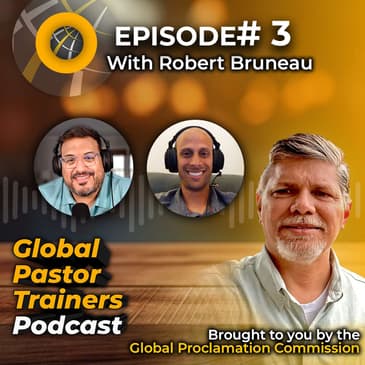
In this episode, hosts Germán Ricca and Robby Richard are joined by Pastor Robert Bruneau, a seasoned missionary and pastor trainer with Mesa Global. Pastor Robert shares his journey from a camp director to a mentor of pastors, offering insights into the balance between character and capabilities in ministry. He underscores the importance of taking time for rest and reflection to maintain spiritual health. This episode is a rich source of encouragement and practical advice for new pastors and seasoned leaders alike.
Visit us in www.gprocommission.org for more information
[00:00:00] Due to our global focus, we are providing this podcast in four major languages.
[00:00:04] While the original interview was conducted in Spanish, AI was used to create the English version.
[00:00:10] While accurate, it may not fully capture the original interviews, expression and excitement.
[00:00:15] We hope it still proves useful and encouraging.
[00:00:18] Welcome to the Global Pastor Trainers Podcast.
[00:00:21] Brought to you by the Global Proclamation Commission,
[00:00:24] where we have the vision to see all Pastor leaders trained and every Pastor a trainer.
[00:00:30] Let's get started!
[00:00:31] Welcome to the third episode of our podcast.
[00:00:33] My name is Hermon Rica, and we're excited to be together once again.
[00:00:37] Third episode, we're thrilled to see our podcast audience growing,
[00:00:40] and along with Robbie Richard, we're hosting this podcast with a lot of anticipation.
[00:00:44] In this third episode, we have a special guest, so I'd like to turn the microphone over to Robbie
[00:00:49] to introduce him.
[00:00:50] Thank you, Herman.
[00:00:51] Yes, it's such a pleasure for us to be back with you all.
[00:00:54] Today we have the privilege and the honor, the opportunity to hear from Pastor Robert Bruno.
[00:00:58] A little bit about him, although we'll hear more in a moment.
[00:01:01] He grew up in a pastoral family, dedicated to ministry,
[00:01:04] he holds a bachelor's degree in physical education and recreation from the University of Panama,
[00:01:08] and God used that career path as he served as the director of several camps in Panama and Costa Rica.
[00:01:13] He was also the executive director of the International Association of Christian
[00:01:17] Camps in Latin America.
[00:01:18] Additionally, for the past 24 years, he has been a missionary with Mason Global,
[00:01:22] currently serving as the regional leader for South America and the coordinator of
[00:01:26] synergy training for Latin America with Mason Global.
[00:01:29] We'll hear more about how he transitioned from camp director to trainer of pastors.
[00:01:32] He's been married to Nina Perez for 28 years, has two daughters, Nicole, 23, and Joan 18,
[00:01:40] and has been living in Medellín for the past eight years.
[00:01:43] He loves the outdoors and enjoys teaching the Bible.
[00:01:46] I can relate to that, Robert.
[00:01:48] He's deeply committed to mentoring pastors and leaders in their walk with the Lord and in their
[00:01:53] overall leadership development.
[00:01:55] Robert, it's a pleasure to have you with us today.
[00:01:58] It's a privilege to join you on this third podcast.
[00:02:01] It's an honor to share and to have listened to the previous episodes,
[00:02:05] knowing that God is using this tool to encourage support and provide us with ideas for our pastoral work.
[00:02:12] So thank you for the invitation.
[00:02:13] That's great. Thank you very much.
[00:02:14] I think I first thought you might as well be.
[00:02:17] I could tell us a little bit about your life in Evangelia.
[00:02:19] Let you to the Lord and eventually, you're going to pastor Son.
[00:02:21] And we also, I'd like to hear about your journey.
[00:02:23] I was born into a pastor trainer.
[00:02:25] Gospel was introduced from birth and that's a privilege.
[00:02:28] It's something God chooses, it's his will.
[00:02:31] I grew up in a Christian home in a pastoral family.
[00:02:34] From the beginning, our church had the pastor's house right next door.
[00:02:38] So for me, the house and the church were like one place.
[00:02:42] Growing up, I had a room that was my bedroom during the week
[00:02:45] and a Sunday school room on the weekends.
[00:02:48] It was an integrated life, faith and church life intertwined with home life.
[00:02:53] However, at the age of nine, I realized it needed to be a personal decision.
[00:02:57] The Gospel touched my heart, not just my mind.
[00:03:00] The message started to sink in and I understood that I was a sinner.
[00:03:04] Even though I hadn't experienced much of the consequences of sin yet,
[00:03:09] like drugs or abuse that you hear in other testimonies.
[00:03:12] But I had a strong conviction of being a sinner.
[00:03:14] And that helped me understand my need for a Savior.
[00:03:17] So it was a response to God, hearing the Gospel and having it moved from my mind to my heart.
[00:03:23] My parents were a huge influence on that transition,
[00:03:26] along with Sunday school, camps and vacation Bible schools.
[00:03:30] All those traditional church experiences contributed to my conversion
[00:03:34] and my confession of faith in Jesus Christ.
[00:03:37] Since I was nine years old, I've been walking with the Lord fully committed, no turning back.
[00:03:42] That decision of faith at nine years old set the course for my life.
[00:03:47] The church has always been a formative space for me, a place for growth and leadership development.
[00:03:52] I'd like to connect this experience with being a pastor's son,
[00:03:56] which I believe is also common among many listeners.
[00:03:59] I've understood ministry since childhood.
[00:04:02] It's not that I transitioned into training pastors, but rather,
[00:04:05] I've always understood the reality of pastoral families,
[00:04:08] the needs of pastors, children, their families,
[00:04:12] and of course the pastors themselves and their wives.
[00:04:15] This has always added significance to what I do.
[00:04:18] It's something the Lord has used to shape my future ministry.
[00:04:22] For me, it provided a great pastoral family experience,
[00:04:25] and now I understand what I'm doing.
[00:04:27] That's good, Robert.
[00:04:29] I imagine many people listening can relate to your story,
[00:04:32] being born into a Christian home, and then starting to walk with the Lord.
[00:04:36] How did you get to the point where you embraced what you're doing today with Mesa Global?
[00:04:42] What was that journey like, and can you tell us more about what you're doing with Mesa Global?
[00:04:48] Of course, I think it's important to understand that God uses all ministries and opportunities
[00:04:53] to train us. He doesn't waste any opportunity.
[00:04:56] Whether it's a prolonged desert of difficulties and weaknesses, or places where you can serve,
[00:05:01] collaborate, and learn from others, God uses it all.
[00:05:06] Praise God since I was 12 years old, He blessed me with mentors and older Christian leaders.
[00:05:12] They were all part of God's gift to me during my formative years.
[00:05:16] Many of them, including my father, taught me the discipline of Bible study,
[00:05:21] reflection on the scriptures, and theological knowledge.
[00:05:24] The process was a bit long 12 years, but I knew the Lord was calling me to ministry.
[00:05:29] By the age of 16 or 17, I was already assisting my father with preaching and teaching.
[00:05:36] My point about service opportunities is that God doesn't waste any opportunity in these areas.
[00:05:42] Even though camps are often seen as places for play and for kids,
[00:05:46] they were actually places for leadership development.
[00:05:49] When we think of leadership, we often think of someone who manages, commands, and controls.
[00:05:55] But the biblical principle of leadership is servant leadership,
[00:05:57] learning to serve, and camps provided that first opportunity for serving,
[00:06:03] whether it was in the kitchen at the pool or meeting kids under a tree to share the gospel.
[00:06:08] The camps gave me a formative experience as a servant leader, being a camp director
[00:06:13] allowed me to meet many pastors. I hosted many churches and had important conversations with
[00:06:18] pastors in my office. When I was 25, 30, or 35 years old, pastors would come and share their stories
[00:06:25] with me. Today, all those stories are a wealth of experience for me. My transition was that the
[00:06:31] Lord gave me the opportunity to join Mesa Global 24 years ago as a missionary.
[00:06:36] Although the cultures are similar in Latin America, I still had a cross-cultural experience
[00:06:41] traveling throughout Latin America, meeting pastors, and developing work teams in some countries.
[00:06:47] Now through the CCI Alliance with Christian camps, we have teams in 10 countries.
[00:06:52] Mesa Global then approached me and said, Robert, we need you to join us in an initiative
[00:06:57] to support pastors and leaders in South America. That's what I'm doing now. We now have a
[00:07:03] network of pastors and leaders in South America, missionaries ministering to congregations,
[00:07:09] others serving organizations with vulnerable children. I'm currently pastoring a team of nearly
[00:07:14] 35 pastors, leaders, and missionaries in South America, including Cuba and Panama.
[00:07:20] Pastoring is a calling, but it's also a great responsibility. It has taken time to learn how to
[00:07:26] shepherd and support pastors well and with enthusiasm. That's good. Listening to your story,
[00:07:32] it seems there's a training path that starts with your dad to you, and now from you to others.
[00:07:38] It brings up a lot of thoughts. First, it's fantastic that your parents involved you in ministry.
[00:07:44] Often, we might not see our family as an ally in our ministry work and instead view them as a
[00:07:49] country. This can lead to negative effects, like resentment in children, which many of us have
[00:07:55] probably seen. But about the discipleship or training, whatever we call it, what does that look
[00:08:01] like now? You mentioned you oversee over 30 different leaders and pastors. What innovations or challenges
[00:08:08] have you faced and overcome? What strategies are you and Mesa Global implementing? What are
[00:08:18] it is important to make a visit? To be with people? South America is obviously a very large
[00:08:23] territory geographically speaking. Therefore, it's important to visit to get close to people
[00:08:30] and to personally support them. The Pauline letters are not the only thing that gives encouragement,
[00:08:36] writing sending messages. That is important. We do that. It is not so innovative, but now
[00:08:41] everybody writes on social media and sends letters. But I think that something that we have certainly
[00:08:46] forgotten is staying in some of the pastor's houses. And it sounds like I am inviting myself,
[00:08:53] but in fact, we are already so close and we already have a deep and profound relationship with them.
[00:08:59] Just living together, being with them. Some of them are very experienced missionaries and spending
[00:09:04] time with them and eating, enjoying going for a walk, listening to their story. Many of them say that
[00:09:11] they don't have such regular times with another leader and they are very grateful when we take
[00:09:16] two or three days to be with them, to play with their children, especially if some of them are
[00:09:22] very young. I think this is a leadership example of being present and not just delivering content.
[00:09:28] Being present as a leader is something Christ centered for me. It is incarnating the model of
[00:09:34] Jesus. It is to cook a fried fish by the river bank and then you can even smell the conversation,
[00:09:39] it becomes more nourished, deeper, closer. And this is something that we are trying to do regularly.
[00:09:46] Another challenge I think for us, especially for me and that is how we handle time to find a balance.
[00:09:52] Now this is true for any pastor anywhere and in any culture. We don't know how to stop.
[00:09:58] One challenge is to find those moments to stop and to go and visit another who is also busy.
[00:10:03] This is something that I teach a lot in training and in pastoral formation and I try to encourage
[00:10:08] it among the pastors and that is before going into a new year to plan those moments to stop.
[00:10:15] Not to wait until they are tired to say, look I need to stop now.
[00:10:19] Now burnout and emotional burdens are very common nowadays. Look, the first thing they ask you to
[00:10:24] do when you are burned out is to get a place to rest. Another recommendation is to look for a hobby.
[00:10:30] Something that can help you get your mind off things. I started to think why I don't do this as
[00:10:36] something regular in my life to take out time to stop and look for a hobby.
[00:10:41] Something recreational that can help me to make a cycle and this helps me to have a more healthy
[00:10:46] management of my time. Nowadays, pastors and leaders do not know how to stop.
[00:10:52] And the truth, your mind and robbing, I'm very concerned about that feeling of,
[00:10:55] I am very proud when I say I don't have time.
[00:11:00] Our own practices to intentionally take out some pastors, even pastors from the city,
[00:11:04] and go to a hotel for four days to rest. To talk, there is not much biblical content.
[00:11:10] We even ask the pastors not to preach that next Sunday so that they may have an actual break
[00:11:15] and stop. Sabbath is simply stopping. It is not slowing down. It is not pausing.
[00:11:21] Sabbath actually means to stop. And that is very hard to us. And that is a practice that we are
[00:11:27] trying to make with our pastors and those that we are training, even those church planters
[00:11:32] that are just starting a rhythm of life. That is good to hear.
[00:11:36] I think another part of this is that we don't know how to stop, but there are also expectations
[00:11:41] from others that we, as pastors, shouldn't stop. I just heard a story back in Mediine,
[00:11:47] a pastor told me that once, when another pastor was resting outside in a hammock,
[00:11:52] a lady from the church passed by an asked, Pastor, what are you doing? He replied, just resting.
[00:11:59] She said, but the devil never rests and he responded. Well that's why I don't want to be like the
[00:12:06] devil. It's that pressure from people that the pastors should always be doing something. But when
[00:12:11] we talk about the health of the pastor, if the pastor is in healthy, either will the church be?
[00:12:16] You know Robby, I've been hearing recently about another issue that adds to the complexity.
[00:12:21] We don't know how to rest. We're so used to the external and internal pressure of always having
[00:12:27] to be doing something. We feel as Robert was saying earlier, super good when we can say,
[00:12:32] I have a full schedule. I have no time to rest. But when we do rest, whether because we're close
[00:12:38] to burnout or because of mentor or someone close to us tells us, hey, you have to stop.
[00:12:44] We don't know how to do it. We think rest means doing nothing. And that makes us uncomfortable
[00:12:50] because we don't know how to interact with that feeling. So Robert, I really appreciate your comment.
[00:12:56] This ministry of presence is key. I think we're getting to the heart of the matter.
[00:13:02] A few days ago, we had a meeting. Every first Monday of the month, a group of 140 of us meet on Zoom.
[00:13:08] One of the themes that came up regarding raising up new trainers of pastors is the need for time,
[00:13:14] but not just time to deliver content. Time to spend with someone, to get to know them and
[00:13:20] from that place help them move forward in what God has for them. So Robert, I welcome those two points.
[00:13:26] Even though they may not be groundbreaking, going back to the way the Lord did things
[00:13:31] feels groundbreaking today. I think it's practically innovative. Something no one else is doing.
[00:13:37] We had a retreat. And when I say retreat, I mean, it wasn't a spiritual retreat.
[00:13:40] We withdrew from the city almost 25 pastors from Mededine. In our morning conversations,
[00:13:45] one thing we discussed was that God created man with a rhythm. What was Adam's first day?
[00:13:49] It was the Sabbath, really. Right? So we have a life cycle of work and rest.
[00:13:53] Jesus lived it. He worked. He did ministry, but he would also take his disciples away from the city.
[00:14:00] There was a constant practice of withdrawing. The devil knows there's a blessing in stopping.
[00:14:05] Because when you stop, you have the opportunity to reflect, to look back and say,
[00:14:10] wow, look at what the Lord has done. To look at the present and say, wow, look at what the Lord has given
[00:14:16] me, and to look into the future with hope. But you can't do that when you're constantly running.
[00:14:22] Yeah, right. Running makes you miss the signs. When you're driving really fast on a highway,
[00:14:27] you miss the signals. Sometimes we just need to slow down. The devil knows there's a great blessing
[00:14:33] in stopping and refocusing on Jesus in a cyclical, regular, and constant way. His first temptation
[00:14:40] is to keep us busy, to give us more to do, and to make us feel guilty for resting, because he
[00:14:45] knows the blessing that comes with it. Why is that? Because it's a commandment, not a suggestion.
[00:14:51] It's in the list of commandments. And I think many of us aren't fulfilling it by stopping regularly.
[00:14:57] What a pity that we haven't had to develop a theology of adultery or idolatry,
[00:15:02] but we've had to write books on the theology of rest. We've had to justify why we need to rest
[00:15:07] and explain to pastors with a lot of biblical awareness. Why stopping is a commandment?
[00:15:13] It's written and has been remembered throughout biblical history. So I believe it's a matter of
[00:15:21] us for pastors. In discipleship, that's why the congregation like the sister who told the pastor
[00:15:26] that the devil doesn't rest has these demands, because we're not teaching our churches the process
[00:15:32] of rest. And we use any pretext to avoid it. It's also cultural. There's a work ethic, a whole history,
[00:15:40] a literature on the subject of work and rest that sometimes confuses us and makes us think that leisure
[00:15:45] is the mother of all vices. That's why I think there's an important reflection needed so that the
[00:15:51] pastor can teach and maybe even practice rest with the congregation. I think part of that is also our
[00:15:58] own independence and autonomy. We sometimes feel like we have to be the saviors of our congregation,
[00:16:04] but in reality it's still about our identity. That's why when I see pastors who are no longer
[00:16:10] pastors, they don't know how to live anymore. They've been stripped of that identity of responding
[00:16:15] to all the needs of the people, which is good, but they placed their whole being in that role
[00:16:21] and they promoted it. And we justify it because we're in ministry. If we did something else,
[00:16:27] people might notice it's not right, but because we're in ministry, we justify it. Thank you for that.
[00:16:33] I think it's very applicable for those who are listening. In closing, Robert, we didn't want
[00:16:39] to take up too much of your time, but maybe regarding that. Or perhaps something else,
[00:16:44] what words of encouragement or suggestions would you have for new pastors and trainers of pastors
[00:16:49] who are just starting out? How would you encourage them as they begin their journey or in what they
[00:16:54] are already doing? Yes, I'm very encouraged by Psalm 78-72. It's a passage that gives me a balanced
[00:16:59] view of David's life. Generally, when we talk about pastors accompanying pastors or pastoring pastors,
[00:17:06] we focus a lot on the skills, the work of the pastor, giving him more tools and ideas about
[00:17:12] evangelism and discipleship and checking in on how he's doing with the church. However,
[00:17:18] this text speaks to me about shepherding according to the integrity of the heart. That has to do
[00:17:23] with character. And character is developed when you have a rhythm of balance, when you take time
[00:17:29] to develop that character. When you look at the past, the present, and the future during a time of
[00:17:35] stopping allows you to examine how you're growing, how you're developing. And when you are
[00:17:40] a shepherd of shepherds, you must first learn to stop. Dealing with content is important,
[00:17:45] but character is crucial. The presence of the pastor is vital because it's about who you are.
[00:17:52] You can't hide who you are in someone else's house. For me, character is something that can be
[00:17:56] modeled. The idea is to model this in the life of your shepherds. The other part of the Psalm
[00:18:02] says and he shepherded them with the skill of his hands. So there were skills, qualities,
[00:18:08] and tools to be used in shepherding. I believe in balancing character, which is the being
[00:18:13] with the skills needed to shepherd. Some pastors have a lot of skills for preaching and teaching
[00:18:19] the Bible, but they still struggle with character issues like anger. Others are very vulnerable,
[00:18:25] but lack leadership skills. I would encourage new pastors to find that balance between
[00:18:30] character and the skills of the hands and to be present in people's lives.
[00:18:36] Take time to just be one encouragement, and this is something I'm living,
[00:18:40] is to not only think of your congregation outside as your flock, but also remember your first
[00:18:45] congregation, your family. I'll end with this. One day the Lord woke me up at 3 a.m. and took
[00:18:52] me to Ezekiel 34. I began to read about the judgment on the shepherds, and I didn't think about
[00:18:57] my congregation first. I thought about my family, my wife and my daughters. I asked myself,
[00:19:03] what am I doing? How much time am I spending being busy with others while possibly neglecting
[00:19:09] my first flock, my family? It struck me that a word of encouragement is to not only dedicate
[00:19:15] a ministry of presence to those who are accompanying, but also to take care of our main permanent
[00:19:20] flock, which is our family. They will be with us for the rest of our lives. Thank you so much,
[00:19:26] I really want to thank you for being on this episode, and for your vulnerability and advice
[00:19:31] on balancing character and capabilities, and for reminding us to look at our family as the first
[00:19:36] place to practice the ministry of presence. Thank you to all of you who are listening as well.
[00:19:41] We want to hear from you so we encourage you to reach out to us on social media at G Pro Commission.
[00:19:46] Let us know your thoughts on this episode and the podcast. We're growing in audience,
[00:19:50] thanks to the Lord, our audience is global. And we have the opportunity to hear from men like Robert
[00:19:55] a pastor who trains pastors. The beautiful message he shared with us is to keep in mind the
[00:20:00] intentionality of working with people, having a vulnerable heart, a pure character, and letting the
[00:20:05] Lord work. So thank you for being with us, Robbie. Do you have any final words?
[00:20:09] Thank you so much, Robert. That brief exposition on Psalm 78 verse 72 was really impactful,
[00:20:14] and I'll definitely be reflecting on it. If someone wanted to reach out to you, what would be the
[00:20:19] best way to get in touch? The best way is to write to me. What's up is an easy option, but you can
[00:20:23] email me at arbrunoatmesaglobal.co. Great, thank you!