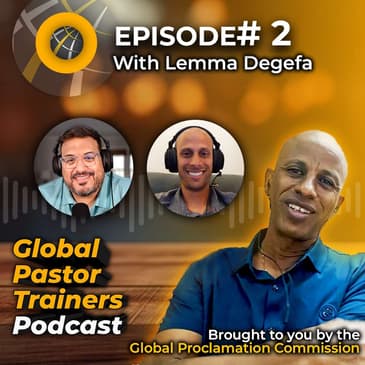
In this episode, our hosts interview Lemma Degefa, an expert in organizational development, growth strategy, and leadership. Lemma discusses his involvement in training pastors in Ethiopia, focusing on research, curriculum development, and raising new trainers. He emphasizes the importance of research in understanding pastors' needs and developing effective training strategies. Lemma also highlights the significance of the nonformal pastor training sector collaborating with both formal theological education and informal personal mentoring sectors. Through their efforts, Lemma’s team has trained over 168,000 pastors in Ethiopia, leading to church growth, healthier pastors, and greater unity among them.
To download the document mentioned in the interview, please click here.
Visit us in www.gprocommission.org for more information
[00:00:00] Welcome to the Global Pastor Trainers Podcast. Broad to you by the Global Proclamation Commission, where we have the vision to see all Pastor leaders trained and every Pastor a trainer. Let's get started. Come everyone, once again to the Global Pastor Training Podcast.
[00:00:17] My name is Robbie Richard and I'm here with my colleague, Hedemann Rika. And today we have the opportunity, the privilege of interviewing a good friend of ours, Lima Degefa. Lima Degefa and I have known each other for quite some time.
[00:00:31] And it's been a huge blessing for me personally to get to know him and hear all of what he's doing. As a short overview, he is an expert in organizational development, growth strategy and leadership coaching.
[00:00:43] He served as an executive director, leadership advisor and chief strategist for different local and international organizations. Retina Cross Ethiopia, where he's from as well as beyond their in Africa and all over the world. And so he's currently pursuing his PhD strategic business leadership.
[00:01:02] And he's the founder of Leadership Transformation Ministries. However, where we are very interested in getting to hear all that he's done with the training of pastors and the training of trainers of pastors. That's what we want to focus even as we begin the recording today earlier.
[00:01:19] We were talking about three different areas, but all that he is working in that is curriculum development research and the training of trainers. And so we're looking forward very much to hear from you, Lima as we get into this interview.
[00:01:36] Thank you so much for being here with us today. The great pleasure to have the opportunity to be on the podcast. And as I said before, we've known each other for a long time. So, so good to see your face. We have matching haircuts.
[00:01:53] So those of you who are not watching us on YouTube, you can just imagine. Why don't you begin by telling us Pastor Lima, how did you come to faith? Well, thank you. You know, this was 25 years ago.
[00:02:09] And through the testimony of a friend of mine, who was a primary school teacher, where I used to live. And before that, I never heard really about the message of the gospel.
[00:02:25] And then since then, got took me through different wood pathers and abs and downs through prayer, support of the church, by a Buddhist study and ministry, he asked me to this day. So that's the way I came to Christ. Well, that's good. That's wonderful.
[00:02:45] So great to be here in this episode. Brother, as you know, one of the main focus of our podcast is on trainer pastor. And you are a trainer pastor in Ethiopia and worldwide.
[00:02:58] Your curriculum is amazing. He had a beautiful thing that the Lord has allowed you to do. But we would like to hear from you how you become a trainer pastor. How was your journey in becoming a trainer pastor? Thank you. Very good question.
[00:03:16] Two major things that got used to lead me into this ministry. The first thing is that 2006 Global Proclamation Academy, which was organized by Rich, you know, really I had some idea before that, you know, they need to train pastors and so on and so on.
[00:03:40] But then the calling to be more intentional and to do more. And also really understanding the depth of the need and then the emphasis came during that time, the GPA 2006 when I was when I attended that in Dallas.
[00:04:03] Texas and then I came back to Ethiopia and I did study National Studies that I didn't really know where to start the training. So I had to do some survey. A nationwide survey to understand where the churches are, what are some of the internal strength and challenges,
[00:04:23] what are some opportunities and you know, train sensor on. What are the needs of the pastors? So the finding was really very, very shocking to me back then 52% church pastors never had a training.
[00:04:40] But there are still active in the ministry leading churches, discipling people and so on and so on. So those two things are kind of a turning point in my ministry and to really focus at be more intentional in training pastors. Yeah.
[00:05:00] One thing I think you were talking Robbie at the beginning of the three main focus of training pastor, the pastor Lama had.
[00:05:10] And we just heard that the research was the first step that kind of led you into getting more involving training pastor, but the research was mainly in the nation of Ethiopia, right?
[00:05:24] Have you experienced, have you heard more about what's going on worldwide or even in the continent of Africa? Can you maybe tell us more about that?
[00:05:34] So yes, through the GPN and the connection through the GPA, I had some exposure to global data and how the church is doing globally. And I continued to learn more and do some more research online and also through my networking Africa.
[00:05:55] So really Ethiopia was not different, you know, the need is everywhere so the overwhelming global call. So yes, I was particularly doing research in Ethiopia but I was also allowing myself to learn what is happening globally and also in Africa, considering the training of pastors.
[00:06:17] Lama, as you're talking about that, can you highlight the need for research? So, you know, give us the foundational why we don't want to just be going off of anecdotes, right? We don't want to just be going off of hearsay or stories.
[00:06:36] So why don't you tell us a little bit of your process or methodology and how just for those who have us are listening and maybe we don't know where to start like you said, And maybe get a little bit more in depth than that.
[00:06:49] Yeah, thank you. I mean, you know, it shouldn't really be a very thorough, very scientific resource consuming research, you know, but using every opportunity to understand what is happening on the ground.
[00:07:06] You know, how are the churches doing, you know, and having that connection and desire to learn, you know, how the churches and how the pastors are doing on the ground.
[00:07:21] And looking around also who can provide, you know, support to the church pastors, you know, meeting those needs and not just me or the ministry that I'm in but other
[00:07:33] ministries, other individuals who would really be willing to help. So, and also even for all research is also going to be very helpful, you know, if possible, if time and resource allows
[00:07:47] getting into the depth and understanding, you know, looking within the church and also the context within which the church is serving at a given particular time.
[00:07:59] So even, the most effective leaders and ministers are those who allow themselves to really explore the field, you know, and see what is happening instead of just depending
[00:08:14] heavily on the core that we have because God is calling us into a context, and it's up to us to pose and understand and explore the context that we serve in.
[00:08:25] And I kind of, I kind of show you the effectiveness of what we have done, the things that we have accomplished so far, the, the basis for all of that is the research that we did, you know, we, it informed us
[00:08:40] that the depth and the scope of the need, it informed us, you know, how to respond to those needs. And then we came up with customized highly tailored curriculum for that, but particular need.
[00:08:52] Instead of just imposing what we feel, you know, like doing to the church and to the pastor. So it is a key to understanding, a key to developing a strategy and also to keep it key to minister, it's minister effectively to those pastors.
[00:09:08] That's wonderful. I think it's very needed sometimes and I've seen this a lot, you know, we might just kind of parachute in or we drop in to a zone wanting to share our curriculum or our ideas with local pastors or local congregations and yet they're actually not responding to any need.
[00:09:27] So if we begin from what I hear you're saying, we begin with the needs by doing the research and then coming up with a strategy to respond to those needs then we can come up with something highly specific to the context.
[00:09:47] I, Robbie, you're saying it's something so right on because even I have experiencing the past being in a place training in a country and reproducing the training. You'll find two or three other organizations of trainer pastor.
[00:10:03] He did on the same topic, but no addressing the main need. So research and sounds like a key and I know sometimes the urgency of the cause.
[00:10:13] It kind of a put us in this speed mode. I need to go and address this and it's running to and I already have this curriculum developed for this, but stop slow down.
[00:10:25] Take your time for research as Pastor Lema was sharing it sounds like a key a very important way to move forward.
[00:10:34] Did the research and maybe this can help with our next question, did the research help reveal some of the challenges as well as help you all come up with creative or innovative approaches that you've experienced or practice and maybe share some stories of that.
[00:10:52] Yes, of course. I very strongly believe it's a best practice and also necessarily practice in training pastors.
[00:11:04] As you all know, you know, Jesus was encouraging his disciples to open up their eyes and see the harvest before doing anything else because what you see with guide you or detect your action.
[00:11:19] So yes, as a result of that research that we did, you know, we just want the one thing that we learned, the Negroes over World Bank said national need it's across denominations in the whole of Ethiopia.
[00:11:37] It's not like one time commitment, but it is a kind of a long term even live time commitment. So prayer fully we have to think through and ask God, you know, and then commit our time and make it our priority.
[00:11:55] And of course, the top priority not to do it just in a conventional way but in unconventional way, you know, mobilizing others. It was also beyond our capacity. So we need then we prayer fully decided to mobilize volunteers even the expertise that it requires.
[00:12:18] It was beyond our capacity, our spirit of expertise. Then we had to go to formal training in institutions and then consult them and see if they can help us. So for instance, when we developed the curriculum.
[00:12:36] We knew the felt needs of the pastors, but then we were not really sure if what we developed is going to be interdenomational acceptable and effective.
[00:12:47] If it may accomplish the purpose that we're seeking to address. So the formal training, theology training in the institutions came along five of them and helped us to frame to develop and to come up with a much more effective.
[00:13:06] Training curriculum that is for all the different denominations. So it is very critical, you know, it informs you strategy, it really informs everything that you do.
[00:13:19] It's also is a baseline, you know, if to go back and see what we've done has accomplished something. So, but, automatically, we do like as impact assessment every three years in our case.
[00:13:31] So the baseline that is that the research itself, you know, that was where it was. You know, if we have made any progress then again is that it helps you to measure.
[00:13:42] You know, they impact of what we have accomplished. So it's a very comprehensive, very significant element and piece of what we do not for me, it is necessary.
[00:13:54] It's where we should start doing fast-rout training. I mean, we should stop everything and then go back to training, doing research but we have to integrate mainstream research activity and everything that we do. That's what I'm saying.
[00:14:09] And it sounds like as well that you are able to work across sectors, both non-formal and formal. And I imagine the informal was happening as you as your mentoring and coaching people.
[00:14:23] And so because of that, the research then I would imagine you can take it to these formal institutions or formal trainers and say, hey, this is what we're finding. How can you help us with this?
[00:14:34] And like you said, I think that humility, the posture of humility where hey, this is beyond our capacity and this is something that only God can do through all of us. That is very powerful.
[00:14:47] Yes, because we are not building our own kingdom. We are in the business of building God's kingdom and it takes all of us. That just one of us. So bringing others along and validating through the formal training institutions, what we know that we're going to use.
[00:15:10] And also recognizing and encouraging that informal kind of engagement, that is already underway in the churches. And so that is a very strategic way of doing this ministry. So yes.
[00:15:26] So Lima, praise well. Yeah, that's amazing. Could you give us an example of how you all went to the say the formal institution, one of these five formal institutions and presented them with the
[00:15:40] the opportunity to come in and help you all. What did that look like? Well, well, actually what we did was we know them and we we walked into the the institution, you know, throughout appointment and then we gave them the report, you know, the report of the research that we conducted, you know, how massive the need is.
[00:16:04] And what we are trying to do to respond to that, these are the felt needs. This is the scope of the need and this is what we're trying to do. We need a tool, a curriculum that we use to train these pastors. So this is the outline.
[00:16:20] So and and we're going to engage every church to the nomination, you know, parents are costals about this the Lutherans and so on and so on. So would this be, would this be sound, the logically, would this be appropriate would this deliver, you know, the the the result that we are seeking.
[00:16:39] So we engaged them actually from the very beginning, we did not publish and then have the stamp at the end of the day, but they were with us from the very beginning.
[00:16:49] Even from the outline how to structure the material. I was the main writer of this curriculum, but so they gave me the privilege to go back to them any time they assigned like experts to help me, the logians and so on. So we actually did it together, you know, and and then finally we had a validation workshop. We had representatives from different denominations.
[00:17:14] And also the theology school leaders were with us. So we explained the process that we went through we had we had the draft in our mind actually it's with me now and then they they they say they commented they they said we did it together this is good for the church of Ethiopia. So we endorse it.
[00:17:33] So that way it was easy that everyone received it and then we will do that tool we started running into the fields and trading pastors. So I'm hearing and what I'm listening for you, Pastor Lema and again thank you for bringing your experience in all this.
[00:17:51] I can I can hear so clearly the you were able to I mean, you were exposed to the need of a training pastor you went back home and then you started doing the research.
[00:18:01] You found there was a huge need in your country and your context, but instead to find the solution by your own self you were just open up for other friends and context institution from the formal sector and that.
[00:18:16] What I really like is that collaboration that you are describing it's not hey I'm the head and I'm inviting you to help me it's hey this is the need that I found it let's do something together because I heard hear you say several times that it wasn't like I did it it was a we did it together since the beginning. I think this is so important because we talk about partnership collaboration and all that so many times it looked like a masking help.
[00:18:46] For my ministry, but what you are saying is is let's build gaps kingdom let's work together let's put all our expertise together and build up something that can be a blessing for training more pastor and that's where you experience I really celebrate that and I hope.
[00:19:03] Many listeners who they are paying attention to this because I do believe radical collaboration is crucial is key for. Keep training more pastor in our context because the need is big it's huge so this is this is so good thank you brother.
[00:19:19] Is definitely one of our values to be able to work cross sectors through the GPRO Commission the global population commission what we're doing and what we're building. Pastor Lema could you share a little bit of what were the results of this collaborative effort then well.
[00:19:37] You know we have some some numbers this is like almost a decade long. Engagement it's not one time training of pastors so we were replicating the trading scaling up and reaching out to more pastors so over the. Over the years we managed to train 250 to 3.
[00:20:03] From all these different denominations and then eventually trained hundred and sixty eight thousand eight hundred and seventy two pastors. Across Ethiopia I mean Ethiopia is a big country by the way we have a hundred twenty.
[00:20:21] Yes, hundred twenty million and then close to thirty million evangelical believers so several churches more so so it's the impact is huge. So you know as a result of that because I said we do periodically we do some impact assessment so we have seen church growing continuously about 8.6%.
[00:20:49] And also the health of the church has improved because pastors are now healthier because of the training they know the understand the Bible. Understand how to conduct ministry how to decipher the levers and also the unity of the body of Christ.
[00:21:06] I mean one of the greatest things that we have accomplished in regard as a complete through as any. The community of learners of pastors or across Ethiopia. The number which I just mentioned they are now connected you know because we don't really want them to graduate from anything.
[00:21:26] We want them to continue to learn and so that community of learners is a big huge huge achievement. I mean of course if we have that community of learners pastors you know in a network sharing experiences and so on and so on a continuous basis.
[00:21:46] I think we can easily address the challenge of pastor at training or the deficit in that sector. So we so yes so that's what we did you know we've been mobilizing volunteers. So you know pastors are more inspired equipped for the ministry.
[00:22:07] I tell there as a result of that the churches are going more connected and so on and so on. So that I think is the huge achievement for which we have very thankful to God and also to to keen partners like.
[00:22:24] The rich ministry you know the deep pro commission the deep pro congress the EPA and all that including yourself. Well as you guys are I mean as you're talking about this is pretty pretty amazing not all success is measured in numbers and I think that's a great.
[00:22:43] Great point that's you're making and you know when we're looking at the health of the church what really is a healthy church what really is a healthy pastor.
[00:22:52] Unity is a great measurement I think and so that's that's wonderful to hear and very exciting and encouraging and motivating and actually. We'd like to finish up you know our time together and it's gotten by quickly but what would be your encouragement or motivation to other.
[00:23:10] Pastor trainers that might be listening to us. I thank you very so much I think. I encourage myself and all of us and all listeners to to really learn from one another you know where we are in the business of.
[00:23:26] Building God's kingdom worldwide so there are best practices that are that are universally applicable like such as the research thing you know developing curriculum like customized curriculum. The the engagement of formal informal and informal and informal.
[00:23:45] Sectors the you know creating community of pastor trainers and learners and so on.
[00:23:52] So these are very and also measuring that the impact of our ministry not just doing ministry but pause and see what we have accomplished you know I get is again is the mandate that that's given us.
[00:24:04] Beyond that when specific to the training of pastors I I I I I believe and I hear globally that you know the Bible is true the harvest is plenty the workers are very few.
[00:24:17] You know it's only through equipped pastors that we can really build the church that that Christ wants to see you know respective nations so emphasis should be given to pastors.
[00:24:30] You know that doesn't mean you know even even the train once I mean those who have diplomas and degrees and PhDs should be learners continuously or share their experience so because the the context within which we are serving is changing you know it is unpredictable.
[00:24:48] You know new mega trains are facing the church so I think learning has to be continuous and the training of pastors must be like the top priority we cannot do.
[00:25:00] The conventional way and I really and expect the church to grow and to grow healthier and so on and more impactful and so on so I think.
[00:25:09] The intentionality you know if it means like I would really suggest like in our case we took it as a project of a decade you know and then.
[00:25:20] We avoided every destruction over the next 10 years this is where you know where we are going to invest our time and energy.
[00:25:27] This is our top priority is this is our brand this is what we are going to do beyond beyond what a single ministry can't do so it's a national ministry now it's a movement now.
[00:25:39] It is it's well accepted by all church in the nominations it's scalable it's reproducible just focusing on that I think that's what we need to do otherwise. We cannot crop up with the challenge the church is growing worldwide that grows you know has to be healthier and then.
[00:25:58] And then I believe that grace of God is also available and I want to encourage everyone to be more intentional prayerfully consider making this a top priority.
[00:26:10] I think that way I think you know we we may we may have a good legacy and we bring glory to God and also be a blessing to our churches and our nations within which we're serving.
[00:26:22] Amen well brother I think I feel like you're just getting warmed up.
[00:26:28] I would like to ask then maybe you know as as people hear you speaking about all this I think it would be beneficial not just in the African context but all over the world is there a way that people could.
[00:26:45] I think that you can find you reach out to you follow you I don't know if you're on social media or anything but if you could.
[00:26:51] Just let us know what the best way for people who would want to learn more about what you've done and hear more will be the best way for them to get in touch with you.
[00:26:59] But I think that the best way is through through this podcast and through reach through the deep rock on risk and also I have you know I am not that very active but I'm on social media so my name is Leama the G5 they type.
[00:27:15] Some of my teachings and some tools are there and actually recently we are just finishing up developing criteria you know not criteria but the marks of healthy low culture how do we really. You know HHS healthy so we put together.
[00:27:33] And kind of indicate and for that so the allergic schools are helping us the same practice that we're applying so shortly we are going to.
[00:27:44] Maybe post make this available on you know video with some explanation and also the template itself so now we are piloting it with 41 local churches in Ethiopia.
[00:27:58] And then the result has been extremely extremely life changing you know and almost half of them have started developing a strategic plan you know we cannot continue like this because of this this process.
[00:28:13] I think that would be one valid tool that would help the churches globally so we would be happy to share that with where we are having it in a local language and also in English.
[00:28:24] Great and we can we can put all these in the show notes and so we can put your information and also where we might be able to access this in the show notes. Yes thank you.
[00:28:39] That's great. Thank you. Pastor Lema this is so so great and so reach I think we all were blessed by listening to you journey and every piece of advice that the you have given us what what I just listened is the whole journey of a man of God who was exposed to the need.
[00:28:58] When back to the homeland started researching and started movement in by the others and I hear you very clear brother when you were saying let's being intentional I think this is so crucial be intentional on training pastor.
[00:29:12] We get this our target for five years staying years removed distractions focus on that God will give you grace to do it and as we heard on pastor Lema in his journey there was a lot of grace and it's still going on I really I blew my mind this this ongoing community of learning.
[00:29:31] This is so amazing and that happened when because as you were saying that the fields ready harvest is ready and we have 52% of people under training your country.
[00:29:41] They were willing to engage and how many more and in our context for those who are listening in our podcast think about your context think about your pastor had a calling and passion they're doing a great job but they need more tools.
[00:29:54] And you can be the one who catalyze and put together many efforts to train more pastors so we want to just encourage you to the your listening this podcast to be part of this movement of raising more training of pastors.
[00:30:08] And I'm becoming a person who embraced that and with a high commitment with the Lord and invite others toward this and this is great so we we praise God for this time together.
[00:30:21] I think we're coming to an end is being a great great episode and as you heard we you will find a notes I'm some resources available in this podcast and also you can follow the GPROM Commission website gprocommission.org and you will get more information about training pastor and we would like to invite you to be part of the community but also you can help us.
[00:30:49] Just subscribing to this channel of podcasts and even maybe sharing this podcast to others we are doing this podcast in multiple languages so which is a great challenge and this is impacting so many many live.
[00:31:03] Again, Pastor lemma thank you for being here. Robby thank you for your leadership and this and as been as been a great time together.
[00:31:12] Please let's get in touch with us until our next episode remember our main main main thing is all pastor or leader train and every pastor a trainer that's something that we pursue and we something they just heard in Pastor Lemma's journey.
[00:31:29] Thank you everybody God bless you and see you in our next episode. Thank you for joining us on the global pastor trainer podcast. We believe Pastor training is key for the health of the church and Jesus mission.
[00:31:43] Whether you're a seasoned pastor, minis, re leader or passionate about training, pastor leaders, formal, non-formal or informal this podcast is for you. Join the GPROM Commission and say connect it on social media and our website for more resources and discussions.
[00:32:01] If the content has been helpful, we will share it to help others benefit. Pastor or health affects church health and church health affects society health. Together let's connect unite and strengthen pastors to advance God's kingdom. Catch you on the next episode.